
Intro
If you’re here, you’re probably tired. Not just “didn’t sleep well last night” tired — the kind of tired that’s been building for months, maybe longer. The kind that makes even the nice things feel like work.
So I want to say this first: you don’t have to do all of this. Not today, not this week, maybe not ever. These are self-care routine ideas designed for exhausted people — the kind of self-care that doesn’t ask you to become a better version of yourself. Just the kind that meets you where you already are.
*Download the free Self-Care Planner printable at the end of this post — a gentle weekly template for slow, sustainable self-care.*
What self-care actually is (and isn’t)
Self-care isn’t a spa day. It isn’t a new morning routine you’ll feel guilty about abandoning in a week. It isn’t about optimising anything.
Self-care is the daily practice of meeting your own needs — food, rest, quiet, connection, softness — with the same patience you’d offer someone you love. That’s it.
Most of us were taught to earn our care. To deserve it. To only rest after the list is finished. But the list is never finished, and the body keeps score of every deferred need. Self-care for tired people starts with unlearning that equation — with accepting that you are allowed to be cared for simply because you’re here.
Why routines help (when you’re depleted)
When you’re exhausted, every decision feels heavier than it should. “What should I do for myself tonight?” becomes one more thing you don’t have energy for.
This is exactly why routines work. A small, repeated self-care practice — something you don’t have to choose, something that just happens — takes the decision off your plate. Your body starts to expect it. Over time, it becomes a signal: this is how I come back to myself.
You’re not building new habits because you should. You’re building them because decision-making is expensive when you’re this tired, and a handful of gentle defaults can carry you through the weeks when you have nothing extra to give.
How to use this list
Don’t read all 30 and plan to start tomorrow. Please.
Instead: pick one. One practice that sounds doable, not aspirational. Try it for three days. If it sticks, keep it. If it doesn’t, try another.
Self-care routines that last are the ones small enough to survive a bad week. The perfect practice you can only do when life is calm is not actually a practice — it’s a fair-weather hobby. We’re not after that.
30 self-care routine ideas for when you’re exhausted
Slow morning rituals (1–5)
1. The five-minute sit
Before your phone. Before the day starts. Just sit somewhere quiet for five minutes, eyes open or closed, and feel the shape of the day before you begin it.
2. One mindful sip
The first sip of your morning drink, fully attended to. Warmth, steam, taste. No phone. Just that. It’s a whole mindfulness practice hiding inside a daily habit.
3. A three-breath pause before the shower
Take three slow breaths before you get in. Set the tone for the morning. That’s it.
4. Open the window for two minutes
Fresh air on your face before anything else. Notice the temperature. Notice the sound of outside. This counts as self-care. I promise.
5. Write one sentence
One sentence about how you feel. In a notebook, on a post-it, on the back of a receipt. Don’t expand. One is enough.
Midday resets (6–10)
6. Leave the desk for lunch
Just once this week. Eat somewhere else. Even if “somewhere else” is the kitchen chair instead of the computer chair.
7. The 90-second reset
Every few hours: stand up, stretch, take three breaths, look out a window. 90 seconds. Set a timer if you need to.
8. A glass of water, slowly
Drink it standing by the window or sitting in the sun. Not while working. Not while scrolling. Just water, with your full attention.
9. Step outside at lunchtime
Even for two minutes. Even if you just stand by the door. Daylight on your face rebalances something the indoor lights can’t.
10. The one-task rule
For ten minutes in the middle of the day, do one thing. Close every tab except the one you’re on. Put the phone in another room. Ten minutes of single-tasking is a whole practice.
Evening wind-downs (11–15)
11. The phone in another room
After 9pm (or whatever time feels doable), the phone lives somewhere else. Read, bathe, sit, sleep. See what shifts.
12. Warm shower as ritual
Feel the water. Notice the temperature. Let it be the whole practice, not just a grooming task.
13. Five-minute stretch before bed
Nothing fancy. Lie on the floor. Let your body undo the shape of the day. Hips, shoulders, whatever asks for it.
14. Read one page
Not one chapter. One page. You’re building a habit of returning to the book, not finishing it.
15. One-sentence evening journal
Mirror the morning practice. One sentence about the day. This is the quietest form of reflection that still counts as reflection.
Sunday anchors (16–20)
16. A longer walk
An hour if you have it, twenty minutes if you don’t. No headphones. No destination. Call it a walk of attention.
17. Plan nothing for a morning
Sunday morning belongs to nothing. No productive projects, no “finally getting around to it,” no catching up. Just the morning.
18. One slow meal
Cook it. Sit at a table. Eat without a screen. Taste the food. A weekly practice. Not every meal — just one, done well.
19. Put the week down
Write a two-minute list of what you’re letting go of from this week. Put it in a drawer. Close the drawer. That’s the ritual.
20. One quiet hour
An hour to do nothing specific. A bath. A book. Sitting in the garden. An hour that doesn’t have to justify itself.
Body-based self-care (21–25)
21. Feet on the floor, every morning
Before you stand up, sit on the edge of the bed and feel your feet on the floor for 30 seconds. A small arrival before the day begins.
22. Hand on heart
Throughout the day, put your hand on your heart for ten seconds. Feel the warmth, feel the beat. Over weeks, your body starts to recognise this as a safety signal.
23. Slow breath, longer exhale
Anywhere, anytime. Breathe in for 4, out for 6-8. Three rounds. Your nervous system responds almost immediately.
24. One proper meal
Not a snack at the desk. Not a thing you eat while doing other things. One meal a day where you sit down and give it your attention.
25. Water before caffeine
A glass of water before the coffee. Small, easy, quietly effective.
Mind + emotional self-care (26–30)
26. Say one thing you need
Out loud. To yourself. To someone else. “I need to close the laptop.” “I need to not answer that message tonight.” “I need a softer day tomorrow.” Speaking needs makes them real.
27. The “one thing” rule
At the start of the day, name the one thing that would make it feel okay. Just one. Often it’s smaller than you think.
28. A gentle no
Once this week, say no to a thing you’d normally say yes to. “Not this time” is enough. No explanation needed.
29. Text someone gently
No agenda. “Thinking of you.” “Saw this and thought of you.” Small threads of connection. They count as self-care too.
30. A five-minute cry or a five-minute laugh
Whatever your body needs. Let the feeling move through. Crying is self-care when you need it to be. So is laughing.
When self-care feels hard
Some days none of this will land. You’ll read the list and nothing will feel doable, and you’ll close the tab and feel worse about yourself.
Please don’t.
On those days, the practice is this: I notice I’m running on empty. I’m allowed to notice that without fixing it tonight. That’s the whole practice. Tomorrow you can try one of these. Tonight, just noticing is enough.
Exhaustion this deep isn’t a self-care problem, exactly. It’s often a boundaries problem, a workload problem, a relationship problem, a nervous-system-regulation problem. If the list doesn’t touch the real issue, that’s because the real issue is bigger than any list. Be gentle with yourself about that.
If there’s resistance — read this

You might notice that the idea of starting any of this feels more tiring than not starting. That’s real. Exhaustion has its own logic — it protects against the effort of change even when the change is for your own good.
Start absurdly small. One breath. One sip. One page. The goal is not a new routine by Friday. The goal is one repeated signal, daily, that says: I’m allowed to take up space in my own life.
Over time, one small practice becomes two. Two becomes a loose rhythm. A loose rhythm becomes a life that has softened a bit at the edges.
You don’t have to earn your rest. You don’t have to earn your softness. You’re allowed to begin tonight, with the smallest possible thing, exactly as tired as you are.
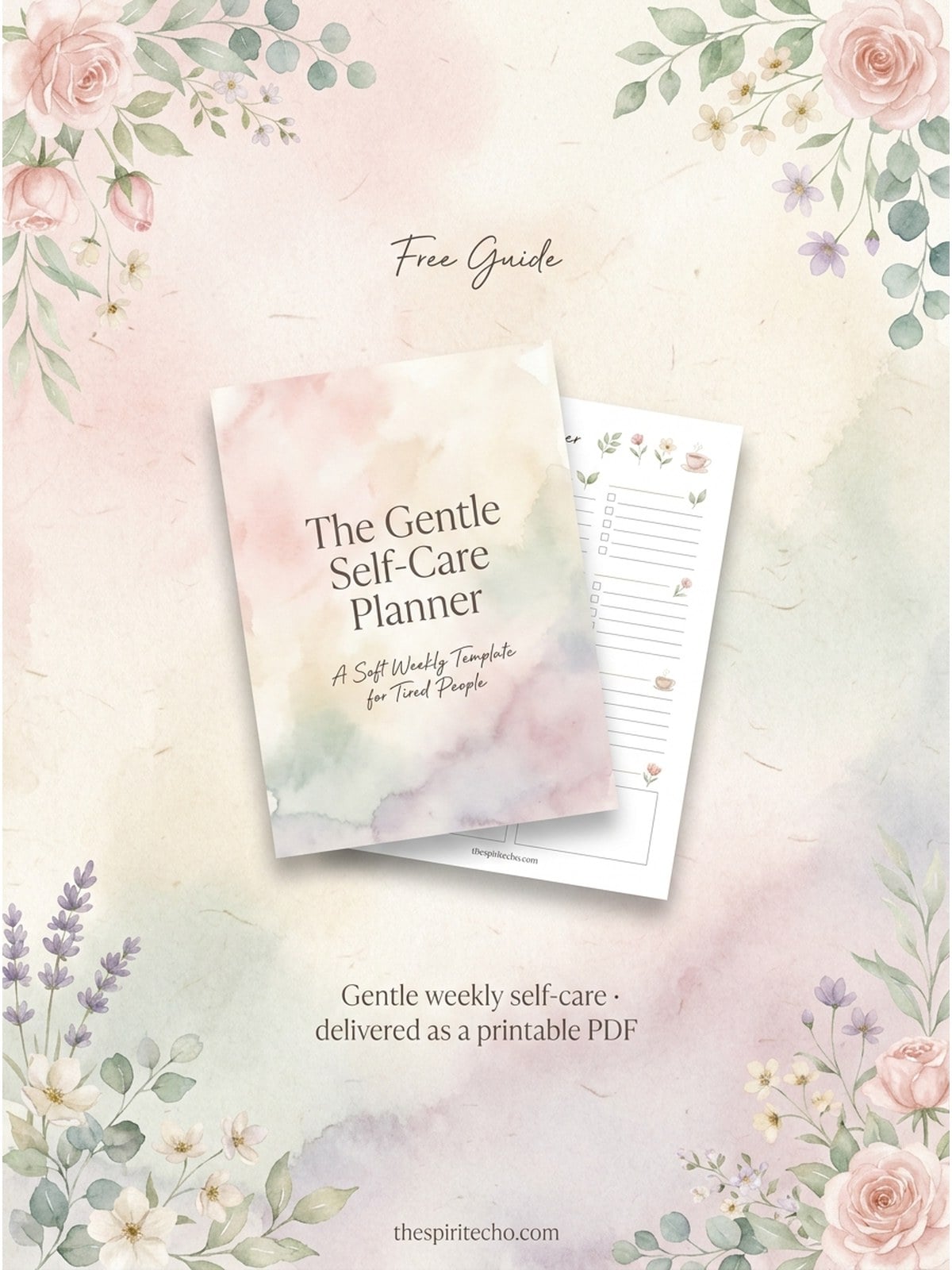
Get Your Free *Self-Care Planner* Printable
A gentle weekly template for slow, sustainable self-care. Designed for people who don’t need another elaborate routine — just a soft structure for returning to themselves on ordinary days.
What’s inside:
- A soft welcome page
- Weekly self-care planner (morning / midday / evening / body / mind sections)
- “One thing” daily anchor page
- A weekly reflection page
- A permission-slip page for the weeks where everything falls apart
Sign up below to get instant access. One welcome email, one printable, no pressure. You can unsubscribe any time.
Frequently asked questions
What are good self-care routines for someone who’s exhausted?
The best self-care routines for exhausted people are the smallest ones. Start with a single 30-second practice — feet on the floor before standing up, three slow breaths before the shower, one sentence in a notebook — and repeat it daily. Tiny consistent practices outperform elaborate routines for people running on empty.
Why does self-care feel so hard when I need it most?
When you’re exhausted, even small decisions feel heavy. Self-care often feels harder precisely when you need it most because your nervous system is in protection mode and treats any change — even a helpful one — as extra effort. The solution isn’t willpower; it’s making the practice small enough that it doesn’t require a decision.
How do I build a self-care routine that actually sticks?
Pick one practice, do it at the same time every day for a week, and don’t add another until the first one is automatic. The most common mistake is starting with a full routine on Monday and abandoning it by Thursday. One small, repeated practice will do more for you over a year than any elaborate plan.
Can self-care help with burnout?
Yes — gentle, consistent self-care practices are part of burnout recovery, but they’re not the whole picture. If you’re genuinely burned out, you may also need to reduce your actual workload, set firmer boundaries, or work with a therapist. Self-care is a necessary support, not a complete solution to systemic overwhelm.
What’s the difference between self-care and self-indulgence?
Self-care usually requires a small act of courage or care — taking a walk when you’d rather scroll, going to bed on time when you’re tempted to stay up, saying no when it’s easier to say yes. Self-indulgence often has a numbing quality. Both have their place, but genuine self-care tends to leave you more resourced, not less.
A soft closing
Pick one. Do it once today. Let it be small.
You don’t need to overhaul your life tonight. You don’t need to become a different kind of person by Sunday. You just need one repeated, gentle signal — daily, for a while — that you are allowed to be cared for in your own life.
Begin where you are. Sit with what’s here. Come back gently, again and again.
Follow along
Find more gentle practices on Pinterest and Instagram.
You might also like
- 20 Gentle Mindfulness Activities for Adults
- How to Regulate Your Nervous System: A Gentle Beginner’s Guide
- Self-Care Sunday: Rituals for a Slower Week
- Free Mindfulness Printables Collection
Pin this for later!
Thank you. Beautiful, calming graphics to go with heartfelt article with so many helpful nuggets.