You know the moment. The day has been long, your mind is buzzing, and your hand is already reaching for your phone before you’ve decided anything at all. Twenty minutes later you’re somehow more tired, a little hollow, and no closer to whatever you were actually hungry for. A dopamine menu is the gentle answer to that moment — a little card of small, real joys you choose from instead of defaulting to the scroll.
Most dopamine menu guides are written like productivity systems — optimise your stimulation, hack your focus. This one isn’t. This is the dopamine menu for gentle souls: three soft courses of calm joy, and a free fill-in printable template waiting for you just below inside The Quiet Mind Kit.
Get Your Free Quiet Mind Kit
A soft 12-page printable kit for worry, overthinking and mental rest — including the fill-in Dopamine Menu from this post (“A fill-in menu of calm joy — gentle things to reach for instead of the scroll”), with write-in lines for your appetisers, mains and desserts, plus a brain dump sheet and five quiet-mind affirmations. The download will appear right here on this page as soon as you enter your email below.
Table of Contents
What is a dopamine menu?
Quick answer: a dopamine menu is a pre-written list of activities that genuinely lift you, organised like a restaurant menu — quick “appetisers,” more substantial “mains,” and “desserts” to enjoy in small servings. You write it when you’re calm, so that when you’re depleted or restless you can choose something nourishing instead of defaulting to your phone.
The idea comes from the ADHD community — Jessica McCabe of How to ADHD popularised it as a kindness for brains that struggle to summon good options in the moment. And that’s the quiet genius of it: the menu does your deciding for you. No willpower required at 9pm. You just read the card and pick a course.
The version we’re making here keeps that structure and changes the flavour. Instead of maximising stimulation, this menu serves calm — small joys that leave you fuller than they found you. Think of it as a menu of mindfulness activities disguised as a dinner card.
Why gentle souls need a different kind of dopamine menu
Quick answer: because most dopamine menus are built for stimulation, and sensitive nervous systems are usually over-stimulated already. A gentle dopamine menu doesn’t chase a bigger hit — it offers a softer one your body can actually receive.
If you’re the kind of person who finds loud rooms expensive and quiet mornings precious, the classic advice — cold plunges, workout playlists, gamified to-do apps — can feel like being handed someone else’s medicine. Your restlessness usually isn’t a craving for more input. It’s a craving for better input: warmth, beauty, slowness, something real under your hands.
The scroll promises exactly that and never quite delivers. It’s a vending machine dinner — technically food, never a meal. A gentle dopamine menu replaces it with what one friend of ours calls slow joy: the cup of tea you actually sit down for, the ten minutes of sky, the page of a novel that feels like home. Small things, honestly portioned, that end with you more yourself rather than less. It’s the same instinct behind the whole soft life movement — choosing ease on purpose.
How to make a dopamine menu in 3 courses
Quick answer: sit down with tea on a calm evening and write three short lists — appetisers (small joys, five minutes or less), mains (half an hour of real nourishment), and desserts (sweet treats, best savoured slowly). Three to five items per course is plenty. Then put the menu somewhere your eyes land before your phone does.
Those three courses are exactly how the printable template in the free kit is laid out, so you can write straight onto the page. Here’s what belongs in each.
Appetisers — small joys, five minutes or less
These are for the in-between moments — the kettle boiling, the meeting that ended early, the restless minute that usually becomes thirty minutes of scrolling. An appetiser asks almost nothing of you, which is the whole point: it has to be easier to start than the phone. Stand at the window. Smell something good. Step outside.
Mains — half an hour of real nourishment
A main is what you reach for when you have a real pocket of time and don’t want to lose it to the feed. These take a little activation energy — gathering the paints, lacing the shoes — so be honest about which ones you’ll genuinely do on a tired Tuesday. The test of a good main: an hour later, you’re glad. That’s the difference between nourishment and stimulation.
Desserts — sweet treats, best savoured slowly
Here’s where the gentle menu differs most from the productivity versions, which treat desserts as vices to ration. We’d rather you choose desserts you can savour without the sugar crash — the comfort show watched on purpose with cocoa, not autoplaying at 1am. A dessert isn’t a failure of discipline. It’s a portion of sweetness, plated deliberately.
One writing tip for all three courses: write your menu when you’re calm and rested, never mid-craving. A menu written at 11pm by a tired brain reads like a hostage note. Sunday evening with a pot of tea is perfect — it folds beautifully into a self-care Sunday.
21 gentle dopamine menu ideas to borrow
Quick answer: borrow freely from the lists below, but keep only what makes you exhale when you read it. A menu of seven true things beats a menu of twenty aspirational ones.
Appetisers (five minutes or less):
- Step outside and feel the air on your face
- Open a window and listen to the birds for two minutes
- Smell something beautiful — coffee beans, a candle, the herb pot
- Water one plant slowly, like it matters (it does)
- Stretch toward the ceiling until something softens
- Write one line in a journal — just the truest sentence of the day
- Stand in a patch of sunlight like a cat
Mains (half an hour of real nourishment):
- Make tea you actually sit down to drink — pot, cup, no phone
- Take the unhurried walk, the one without a destination
- Watercolour one small corner of a page (badly is fine, gloriously)
- Cook something simple while music plays
- Do a ten-minute brain dump, then sit in the quiet it leaves behind
- Tend something — repot the basil, mend the hem, sort the shelf you love
- Call the person whose voice feels like a warm room
Desserts (sweet treats, best savoured slowly):
- Reread the book that feels like home
- One episode of the comfort show, watched on purpose, with cocoa
- A long bath with the good salts you keep saving
- An afternoon nap with the window cracked open
- The fancy chocolate, eaten slowly, doing absolutely nothing else
- A little online wander through beautiful things — set a gentle timer
- Breakfast for dinner, candle lit, because you said so
The free printable dopamine menu template
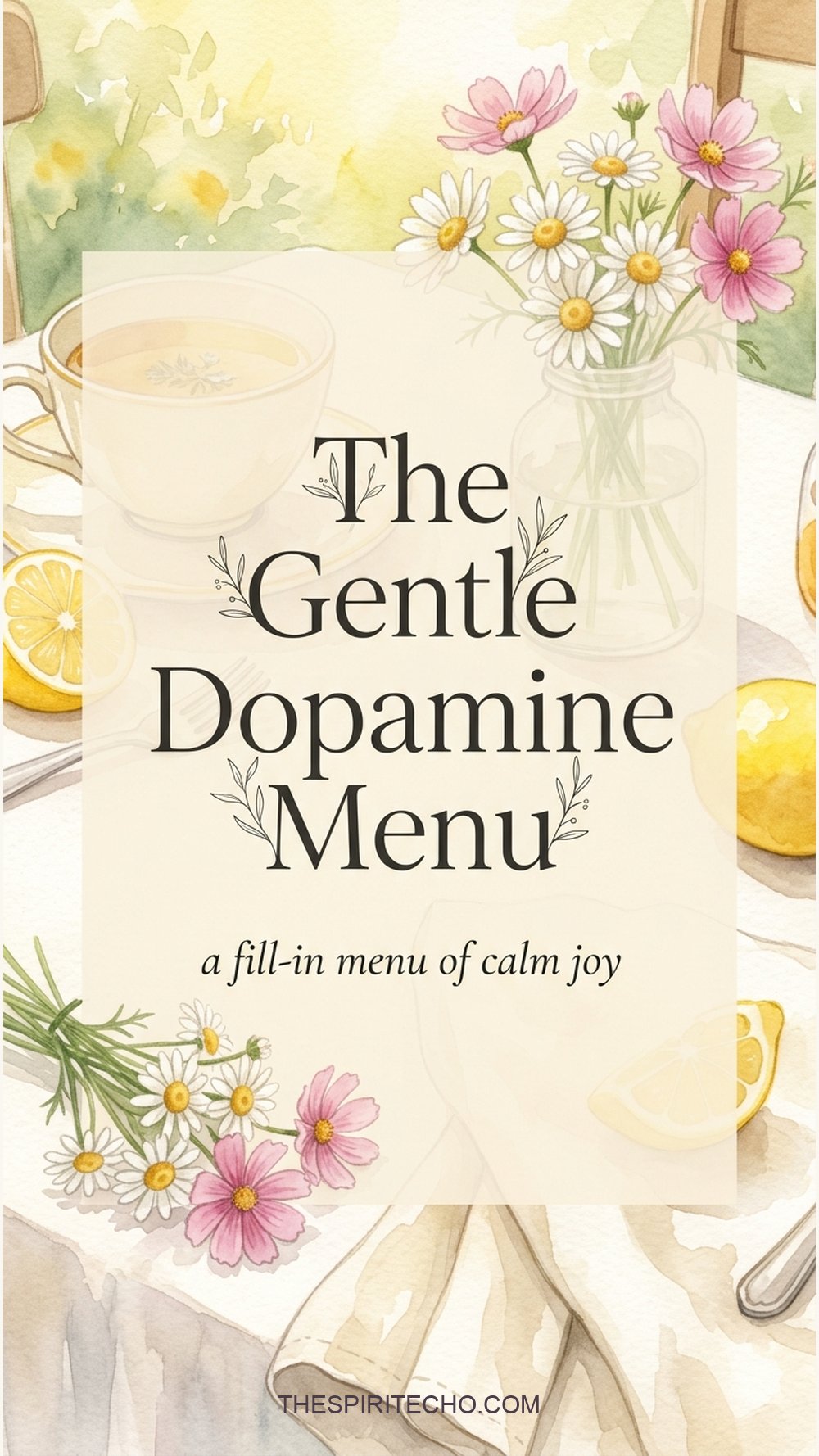
Quick answer: the fill-in Dopamine Menu is page 9 of the free Quiet Mind Kit — one soft A4 page with all three courses and write-in lines for each, under the subtitle “A fill-in menu of calm joy — gentle things to reach for instead of the scroll.”
It’s set like an actual menu — watercolour botanicals, teacups and a slice of lemon around the edges, with three write-in lines under each course: Appetisers (“small joys, five minutes or less”), Mains (“half an hour of real nourishment”) and Desserts (“sweet treats, best savoured slowly”). Blank menus have a way of inviting honesty that lists in your notes app never quite manage.
It comes inside the free Quiet Mind Kit at the top of this post, alongside a brain dump sheet for the nights your mind is too full to choose anything, and five quiet-mind affirmations that pair beautifully with the desserts course. Print a fresh one whenever your seasons shift — a winter menu and a summer menu are rarely the same.
How to actually use it (instead of the scroll)
Quick answer: put the menu where the reach happens — by the kettle, on the nightstand, tucked behind your phone case — and give yourself one tiny rule: read the menu before you open an app. Not instead of. Before. The choosing stays yours.
That one rule is gentler than it sounds, and it works because it doesn’t forbid anything. Some evenings you’ll read the menu and still choose the phone, and that’s allowed — but you’ll be choosing it, which is a different thing entirely from being swallowed by it. Most nights, though, the menu wins, because “make tea you actually sit down to drink” genuinely sounds better than forty minutes of other people’s kitchens.
Two small companions help. First, notice when you reach — for most of us it’s transitions: arriving home, finishing work, the hour before bed. Park the menu at those doorways. Second, if the restlessness underneath is more anxious than bored, start with something that settles the body before you pick a course — these grounding techniques are the kindest first step, and the menu takes it from there.

Frequently Asked Questions
Is a dopamine menu only for people with ADHD?
Not at all — though that’s where the idea was born, and the ADHD community deserves the credit for it. Anyone whose tired brain defaults to the path of least resistance (which is all of us, most evenings) benefits from deciding in advance what “something nice” looks like. Gentle souls just need a menu that serves calm rather than stimulation.
How many items should a dopamine menu have?
Three to five per course is the sweet spot — enough for variety, few enough that choosing stays effortless. A menu with twenty options recreates the exact decision fatigue it was meant to solve. The printable template gives you three lines per course on purpose.
What’s the difference between the appetisers, mains and desserts?
Time and depth. Appetisers are five-minute lifts for in-between moments; mains are half an hour of genuine nourishment when you have a real pocket of time; desserts are pure-pleasure treats, portioned and savoured rather than rationed or binged. If an activity leaves you flat afterwards, it’s not a dessert — it’s a decoy. Take it off the menu.
What if nothing on my menu appeals when the moment comes?
That’s usually a sign you’re depleted rather than bored — and depletion wants rest, not activities. Choose the smallest appetiser anyway (sky, breath, water) and let that be enough. If it keeps happening, your menu may be aspirational rather than honest; rewrite it on a calm evening with kinder, smaller things. These gentle ways to relax are a good well to draw from.
Final thoughts
A dopamine menu won’t fix a hard season, and it isn’t meant to. It just makes the kind choice as easy as the hollow one — a small card standing between you and the scroll, asking quietly: what are you actually hungry for? Write your three courses this week. Put the menu by the kettle. Order the tea.
For more gentle company, come find us on Pinterest — we save soft things there daily.
— Marco & Dee
You Might Also Like
- Mindfulness Activities for Adults — gentle ways back to the present
- Soft Life Aesthetic Pictures — the slow, gentle mood board
- Easy Mindfulness Activities for Busy Days
- Gentle Ways to Relax
- Self-Care for the Highly Sensitive Person
- Self-Care Sunday — gentle ideas for a slow day
Pin this for later