
Anxiety has a sneaky way of pulling you out of the present moment. Your mind races ahead to worst-case scenarios, your chest tightens, and suddenly you’re anywhere but here.
That’s where grounding comes in.
Grounding techniques gently anchor you back to the present — using your senses, your body, and your breath to remind your nervous system that you’re safe, right now, in this moment.
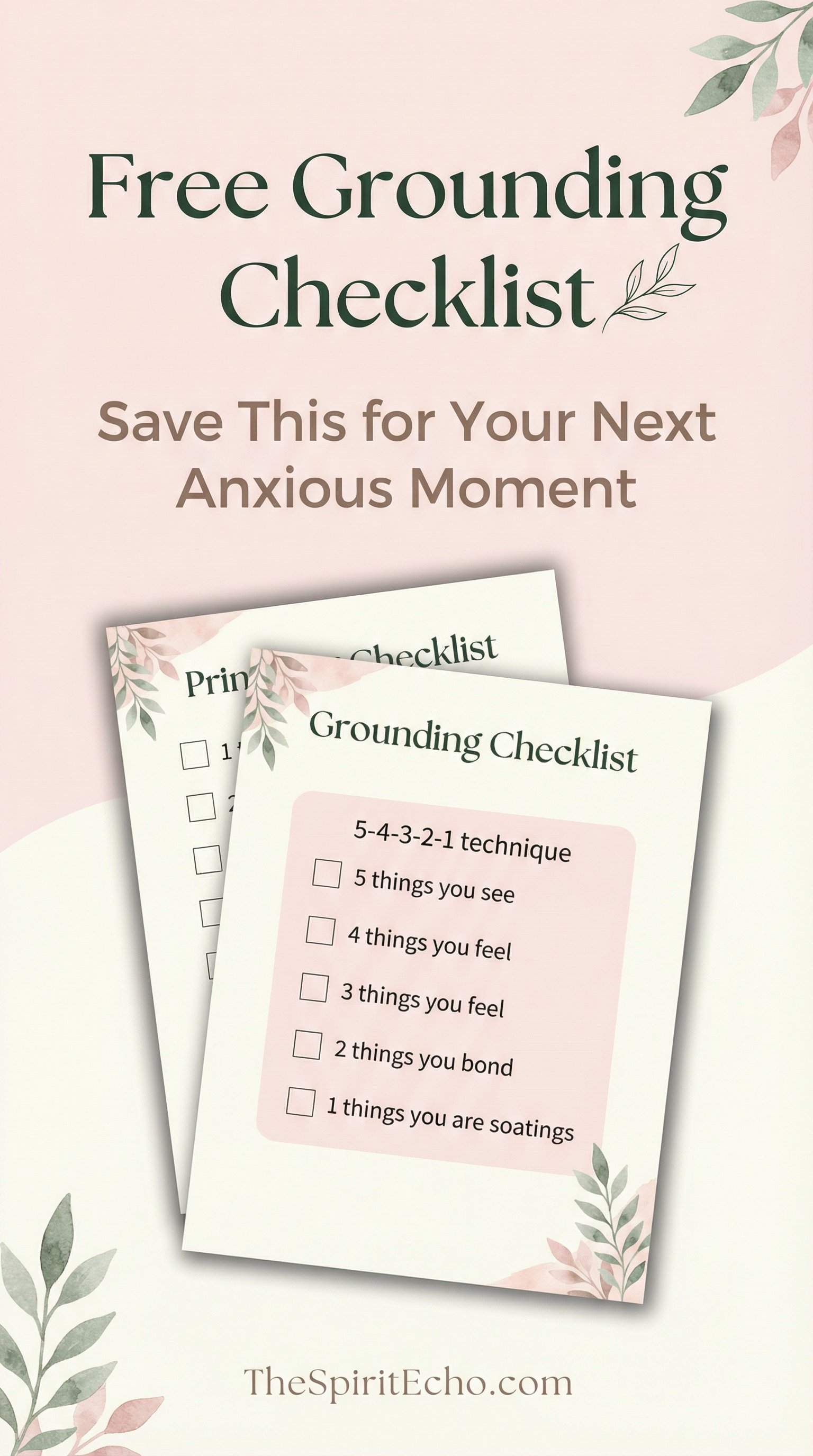
I created this free printable grounding checklist so you can keep these techniques close whenever anxiety creeps in. Print it out, stick it in your journal, keep it by your bed, or save it on your phone. Whatever works for you.

What Are Grounding Techniques?
Grounding exercises are simple practices that bring your attention back to the present moment when anxiety, panic, or overwhelm takes over.
They work by engaging your senses and physical body — pulling your focus away from racing thoughts and into what’s real and tangible right now.
The beauty of grounding? It doesn’t require any special equipment, apps, or training. Just you, your senses, and a few intentional moments.
The 5-4-3-2-1 Grounding Technique

This is one of the most effective grounding exercises for anxiety because it engages all five senses. Here’s how it works:
5 things you can SEE — Look around and name five things you can see. A plant on your desk. Sunlight on the wall. Your coffee mug. Really notice them.
4 things you can TOUCH — Notice textures around you. The fabric of your shirt. The smooth surface of your phone. Your feet against the floor.
3 things you can HEAR — Listen for sounds you might normally tune out. Traffic outside. A clock ticking. Birds. Your own breath.
2 things you can SMELL — Notice any scents nearby. Coffee brewing. Fresh air from an open window. Your lotion or perfume.
1 thing you can TASTE — What flavor lingers in your mouth? Sip some water, chew gum, or just notice the taste of the present moment.
By the time you’ve worked through all five senses, your mind has shifted from panic mode to present mode.
Quick Grounding Techniques You Can Use Anywhere

When you need to ground yourself fast, try these:
Hold something cold — An ice cube, a cold glass of water, or even pressing your hands against a cold window. The sensation snaps your focus back to your body.
Press your feet firmly into the floor — Feel the ground supporting you. You are here. You are steady.
Take 5 slow, deep breaths — Inhale for 4 counts, hold for 4, exhale for 6. Slow exhales activate your parasympathetic nervous system (your body’s built-in calming mechanism).
Name your emotions out loud — Say it: “I am feeling anxious, and that’s okay.” Naming the emotion reduces its power over you.
Splash cold water on your face — This triggers the dive reflex, which naturally slows your heart rate and calms your nervous system.
Clench and release your fists — Hold tight for 5 seconds, then slowly release. Notice the tension leaving your body.

Why Grounding Works for Anxiety
When anxiety strikes, your brain perceives a threat — even if there isn’t one. Your nervous system kicks into fight-or-flight mode, flooding your body with stress hormones.
Grounding techniques work because they interrupt that cycle. By focusing on sensory input (what you see, hear, touch, smell, taste), you signal to your brain that you’re safe. There’s no tiger chasing you. There’s just this room, this moment, this breath.
Over time, practicing grounding regularly can train your nervous system to return to calm more quickly.
Download Your Free Grounding Techniques Printable
I designed this grounding techniques checklist to be simple, beautiful, and practical. Keep it somewhere visible — your journal, your bathroom mirror, your nightstand — so it’s there when you need it most.
What’s included:
- The complete 5-4-3-2-1 technique with check boxes
- 6 quick grounding exercises
- Gentle affirmations for anxious moments
More Ways to Practice Mindfulness
If grounding resonates with you, you might also enjoy:
- Mindfulness doodles — simple, meditative drawing exercises that calm your mind
- Affirmation printables — positive statements to rewire anxious thought patterns
- Breathing exercises — guided techniques for calming your nervous system
Grounding is just one tool in your self-care toolkit. The more techniques you have, the more equipped you are to navigate life’s anxious moments with grace.
Remember: Anxiety is not a character flaw. It’s your nervous system trying to protect you. Grounding simply helps remind your body that right now, in this moment, you are safe.
Save this post for later! Pin it to your mindfulness or self-care board on Pinterest so you can find it when you need it most.
